

Reaching people between destinations.
Understanding Transumers
Consumers Don’t Stand Still. Neither Do Decisions
Transumers are consumers in transit — forming decisions as they move through moments of curiosity, interest, motivation, and choice.
Understanding these shifts helps brands recognize when attention begins to form, when intent starts to emerge, and how relevance is built over time — not after decisions are already made.
For brands, this creates a measurable opportunity — movement reveals when audiences are most receptive, allowing media investment to focus on moments where intent and spending power are beginning to align.

Defining Transumers
What is a Transumer?
A Transumer is a consumer in transit — moving through environments, information, and experiences while decisions form over time.
The Transumer concept
Rather than deciding in a single moment, Transumers progress through subtle shifts in curiosity, confidence, and intent.
These shifts reveal when attention begins to take shape, how relevance develops, and where motivation starts to build.
Decisions emerge gradually, influenced by movement across contexts rather than isolated touch points. Because Transumers are actively evaluating options as they move, they consistently over-index on discretionary spending across travel, luxury, retail, and lifestyle categories.
These characteristics make Transumers uniquely addressable through data-driven media at moments when influence is most effective.
Key characteristics
- Decisions form gradually, not instantly
- Movement reveals early behavioural signals
- Context influences readiness and intent
- Timing plays a critical role in relevance
Why movement matters
Movement is how decisions take shape.
As people move through environments, information, and experiences, their attention shifts, priorities change, and intent begins to form.
By understanding movement, brands can identify early signals of consideration, respond at the right moments, and align before decisions are locked in — rather than reacting after the fact.
By identifying these moments early, brands can shift investment upstream — engaging Transumers before preferences harden and decisions are finalized.
These signals allow brands to prioritize timing and relevance rather than relying solely on channel presence.
Key characteristics
- When attention begins to emerge
- How context shapes interest
- Where intent starts to strengthen
- Why timing influences outcomes
The Decision Journey
The AIMS Framework
A decision cycle that explains how Transumers move from early awareness to confident action.
The AIMS framework also serves as a practical planning model — guiding how media is sequenced, messaging is prioritized, and investment is allocated across the journey.
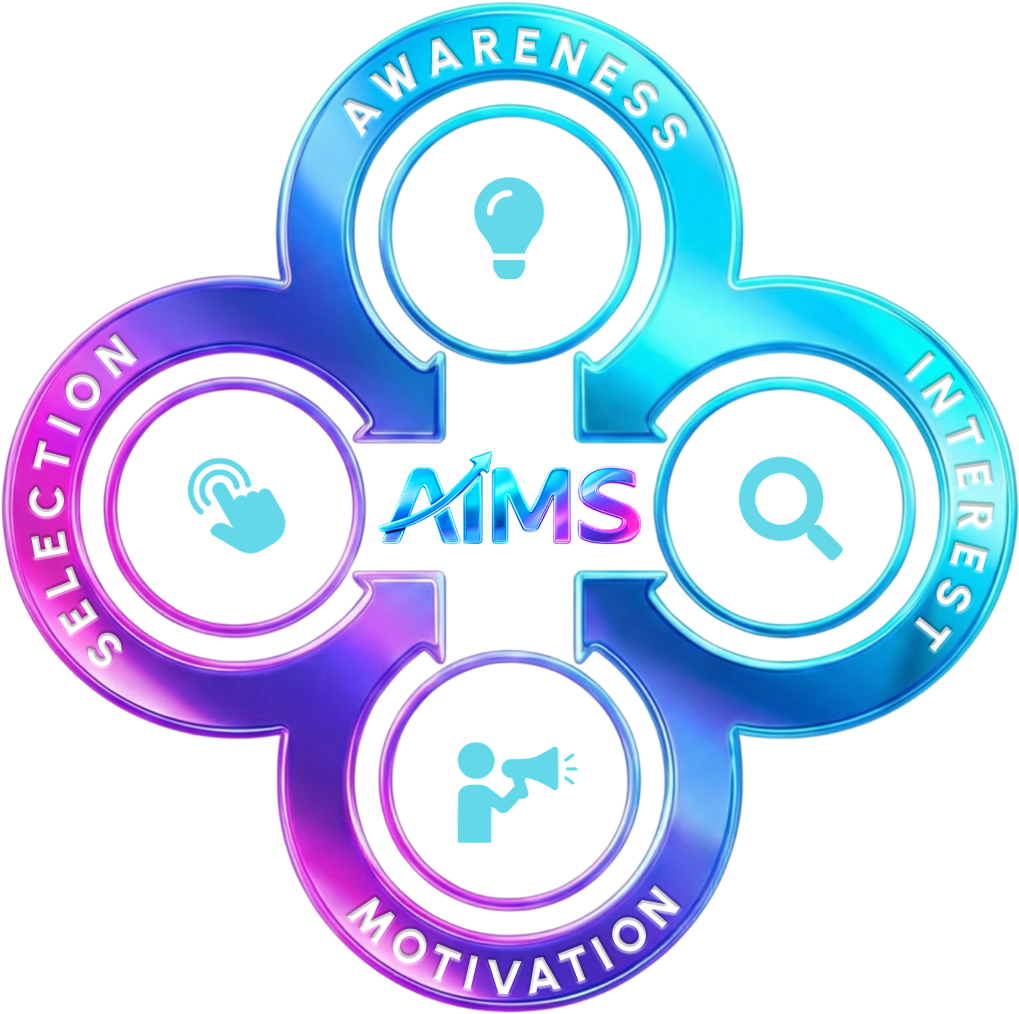
Awareness
Attention is sparked.
Something enters awareness and begins to register — a message, moment, or experience that captures initial attention.
What this reveals:
Early signals of curiosity before intent is fully formed.
Interest
Attention deepens through exploration.
People begin to seek more information, compare options, and engage more actively. Relevance starts to take shape as curiosity turns into consideration.
What this reveals:
Growing engagement and emerging preferences.
Motivation
Value becomes personal.
Interest strengthens as confidence builds. The decision feels increasingly meaningful, and readiness to act begins to form.
What this reveals:
Clear intent and rising readiness to choose.
Selection
The decision is made.
Confidence aligns with intent, leading to action. The choice feels justified, timely, and right for the moment.
What this reveals:
Commitment and follow-through.
Each stage represents a distinct opportunity to align messaging with mindset, increasing efficiency and reducing wasted exposure.
Brand Advantage
How Transumers Create Advantage For Brands
Understanding Transumers allows brands to act with intention — engaging earlier, responding more precisely, and staying relevant as decisions take shape.
For advertisers, this advantage translates into better timing, stronger relevance, and more efficient use of media budgets.
Earlier Insight
Identify intent before decisions are finalized.
By recognizing early signals of attention and curiosity, brands gain visibility into intent while it is still forming — not after outcomes are decided.
This early visibility allows brands to influence consideration while alternatives are still being explored — rather than competing at the point of decision.
Stronger Relevance
Align messaging with mindset, not just placement.
Understanding where people are in their decision journey allows communication to feel timely, meaningful, and contextually relevant.
Better timing
Engage while attention is forming — not after it has passed.
Movement reveals when audiences are most receptive, helping brands connect at moments that influence outcomes.
Greater Adaptability
Respond to behavioural change without losing strategic focus.
As conditions shift, brands can adjust with confidence — maintaining continuity while evolving alongside their audience.
Our Execution
Applying the Framework
The AIMS framework provides a practical way to translate behavioural insight into strategic direction.
It helps teams recognize where audiences are in their decision journey and respond with clarity at each stage. Rather than forcing messages into fixed channels, this approach supports alignment across strategy, media, and execution — ensuring engagement feels timely and relevant as behaviour evolves.
In practice, this means aligning strategy, programmatic media, and execution so engagement remains consistent as Transumers move across contexts.
Interpret signals
What this means
Identify early signals of attention, interest, and intent as they begin to form.
Why it matters
This reveals when relevance starts to build — before decisions are finalized.
Align strategy
What this means
Map messaging and emphasis to decision moments rather than channels alone.
Why it matters
Strategy reflects mindset and timing, not just placement.
Support execution
What this means
Ensure delivery remains consistent as audiences move across contexts and touch points.
Why it matters
Execution feels connected, not fragmented.
Learn & Adapt
What this means
Use performance insight to refine direction as behaviour and conditions change.
Why it matters
Strategy stays relevant without losing focus.